FAQ
Frequently asked questions about industrial automation
Straight answers to what plant, engineering and purchasing teams ask us most before automating a process.
About SIEC Robotics
What does SIEC Robotics do?
SIEC Robotics is a robotics and industrial automation integrator in Saltillo, Coahuila, Mexico, founded in 2014. We design, build and integrate turnkey robotic cells, automated assembly stations, end-of-line testers (EOLT) and traceability systems, under an ISO 9001:2015 quality management system. Since 2026 we are part of ALM Positioners, a U.S. manufacturer of heavy-duty welding positioners.
See our capabilities →Is there a robotics integrator in Saltillo, Coahuila?
Yes. SIEC Robotics has its headquarters and an 8,500 sq ft production space in Saltillo (Calle Tercera 309, La Aurora), with a machining workshop, an electrical control lab and an assembly area. We serve plants in Mexico and the United States, and you can visit us to see equipment before buying.
See our facilities →Which industries do you work with?
Mainly automotive OEMs and Tier 1 suppliers (seating, components, electrical assemblies), plus industrial manufacturers. Through ALM Positioners we also serve heavy equipment, rail and transportation manufacturers.
See projects →Which robot brands do you integrate?
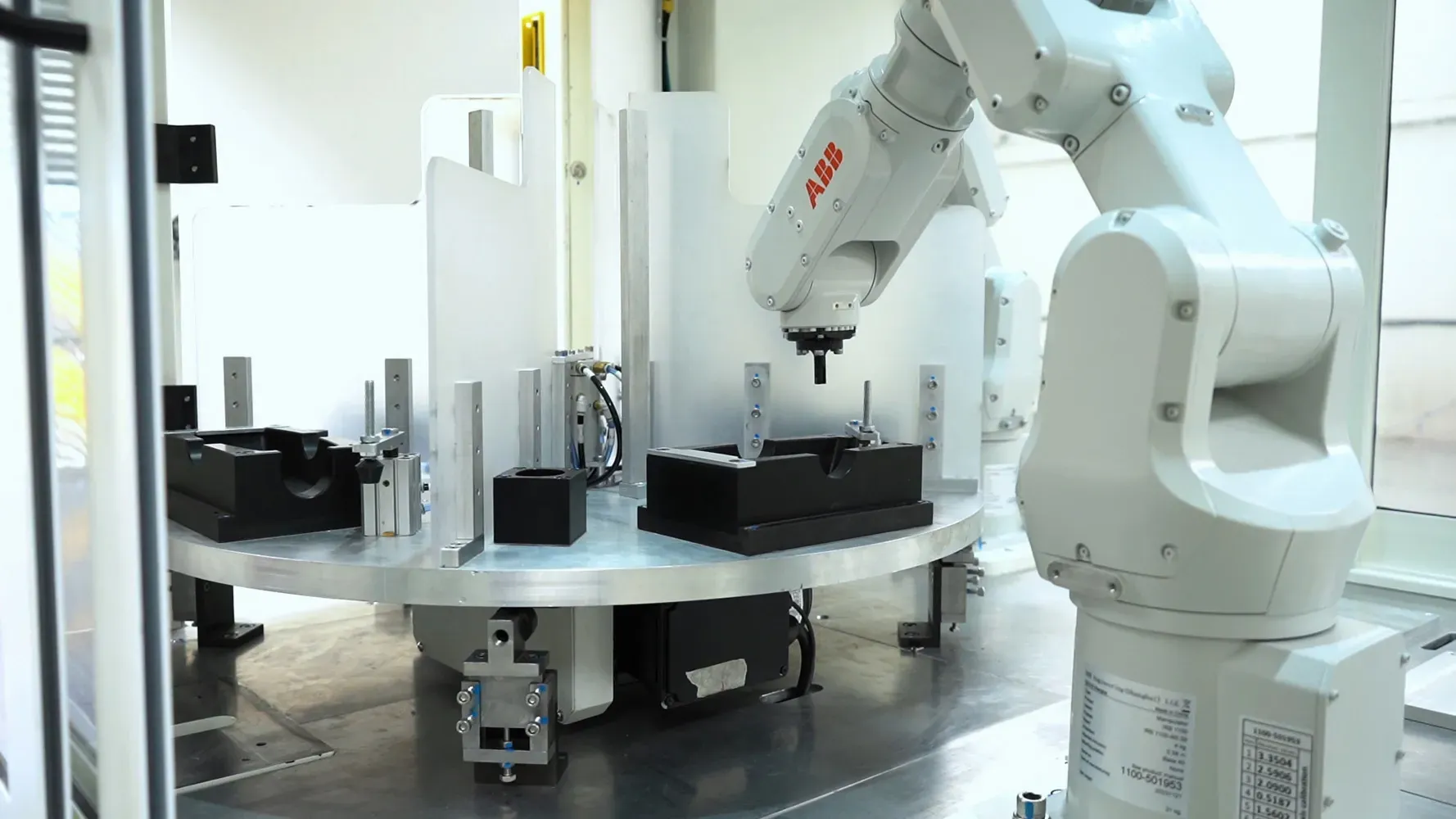
We are brand-agnostic: FANUC, ABB, KUKA, Yaskawa and Universal Robots (cobots), with Siemens and Allen-Bradley PLCs, Keyence, Cognex and SICK vision and sensors, Festo and SMC pneumatics, and Apera AI for 3D bin picking. We pick the robot by reach, payload and utilization, not by brand.
Cost, ROI and timing
How much does a robotic cell cost?
It depends on the process, not just the robot: the robot is usually only part of the cost, and the rest is gripper and tooling, vision, guarding and safety, PLC/HMI, engineering, programming and commissioning. That is why we analyze the process and simulate the cell before quoting, so the price covers a validated process, with no surprises. Send us drawings, an RFQ or a video of the process for a quote.
How we quote →What is the typical ROI of automating a station?
Our turnkey solutions typically pay back in under two years. The return comes from removing operator dependence across shifts (absenteeism, turnover, fatigue), a constant cycle time all shift long, and fewer quality escapes.
How do I know if my process is worth automating?
Good candidates are repetitive, high-volume tasks that run across several shifts, are ergonomically hard, or depend on one person. Send us your RFQ, drawings or a video of the process and we will tell you if it makes sense to automate. If it is viable, our Simulation Lab models the cell and the cycle time against your takt before you commit.
Simulation Lab →Can you simulate the cycle time before I buy?
Yes. For viable projects we simulate the station in RoboDK and Visual Components: a 3D layout at real scale, the cycle time broken down step by step against your takt, the bottleneck, and the risks that must be confirmed with a trial. We quote a validated process, not just a robot.
See a real example →What do I receive with a turnkey project?
The running machine plus a complete documentation package: source code, BOM, critical spare parts list, operation and maintenance manuals, electrical diagrams, 3D/2D drawings, technical sheet and training for your team.
Applications
What is bin picking and when does it make sense?
Bin picking is a robot with 3D vision taking randomly piled parts straight from a bin and placing them into your process. It makes sense when an operator spends the shift picking bulk parts one by one to feed a machine, fixture or indexer. Modern 3D bin picking reaches 98 to 99.5% first-attempt pick accuracy; we use Apera AI as our reference platform.
See a bin picking project →Do you build robotic welding cells?
Yes: MIG, TIG and resistance welding cells, plus ultrasonic welding and automated soldering in assembly stations. With ALM Positioners we deliver the complete cell (robot, ALM positioner synchronized with the robot controller, and SIEC integration), and ALM positioners are now also built in Mexico.
ALM + SIEC →What is an end-of-line tester (EOLT)?
An EOLT is the final station that checks every part before it ships: leak, flow, electrical and functional tests, dimensional measurement with laser profilers, and machine-vision inspection, with the results saved for traceability. We design and build them to your specification.
See an EOLT project →Can you automate a station on my existing line?
Yes. Many of our projects add a robot to an existing press or station without replacing the equipment or changing the process flow, for example a 6-axis pick & place cell that took over loading a double press on all three shifts.
See the project →Do you offer traceability and part marking?
Yes: laser, micropercussion and ink marking, barcode, QR and RFID reading and labeling, PLC programming for traceability, and integration with your MES/ERP databases.
See traceability →Service and support
Do you support plants in both Mexico and the United States?
Yes. With ALM Positioners we have local teams in Saltillo, Mexico and Rock Island, Illinois, for commissioning, service, spare parts and training in Spanish or English: one integration partner for plants on both sides of the border.
How do I start a project with SIEC Robotics?
Send us your requirement by chat, email (sales@siecrobotics.com) or WhatsApp (+52 844 668 2028). We meet with your team or visit your floor, send the quote with a simulation, and with your purchase order the project starts under our ISO 9001 system.
Contact us →Let's talk about your production
Schedule a technical visit, or tour our facilities in Saltillo, Mexico or Rock Island, Illinois. We will study your parts and your production goals and propose the right solution, not just a quote for a machine.